20 Continuous Shots Followed by Siddhartha (2016): Full Movie Information — Cast, Story, Songs, Trailer & OTT Release
20 Continuous Shots Followed by Siddhartha (2016): Full Movie Information — Cast, Story, Songs, Trailer & OTT Release
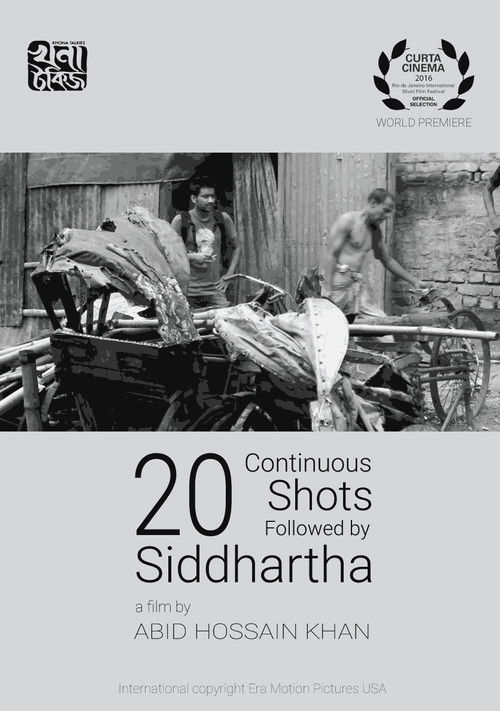
In the midst of Hindi cinema's penchant for melodrama and spectacle, '20 Continuous Shots Followed by Siddhartha' emerges as a refreshing anomaly, a 20-minute Bengali short film that eschews grand narratives for a more intimate, observational approach. Director Abid Hossain Khan's cinematic debut is a slow-burning, meditative exploration of the human condition, one that finds the protagonist, played by the director himself, navigating the cacophonous streets of Dhaka in search of moments of stillness and clarity. This is a film that wears its influences on its sleeve, from the lyrical camerawork of Satyajit Ray to the philosophical musings of Jean-Paul Sartre, yet somehow manages to carve out its own unique niche within the realm of Hindi cinema.
Quick Facts
| Release Date | 1 January 2016 |
| Genre | Short |
| Language | Bengali |
| Runtime | 20m |
| Director | Abid Hossain Khan |
| Producer | Khona Talkies |
| Writer | Abid Hossain Khan |
| Cinematography | Dibbyo Samadder |
| Editor | Mohammad Raju |
Story & Plot
At its core, '20 Continuous Shots Followed by Siddhartha' is a film about the search for meaning in a world that seems determined to drown out the human voice. The protagonist, a young man played by Abid Hossain Khan, wanders the streets of Dhaka, crossing bridges over open sewers, as the sounds of the city – from radio advertising to religious sermons – create a constant, overwhelming din. It's a powerful metaphor for the modern condition, one that finds us struggling to find our place in a world that seems increasingly chaotic and overwhelming. Throughout the film, Khan's cinematographer, Dibbyo Samadder, employs a visual language that is both poetic and unflinching, capturing the beauty and ugliness of the city in equal measure. The result is a film that is both a love letter to the city and a scathing critique of its excesses.
Cast & Crew
Abid Hossain Khan is the driving force behind '20 Continuous Shots Followed by Siddhartha', a film that is both a showcase for his talents as a director and a testament to his versatility as an actor. Playing the protagonist, Khan brings a sense of vulnerability and determination to the role, capturing the character's search for meaning in a world that seems determined to drown him out. The chemistry between Khan and the city itself is palpable, with the director using his own body to navigate the streets and alleys of Dhaka. It's a bold move, one that pays off in spades, as Khan's performance adds a sense of intimacy and immediacy to the film.
Lead Cast
| Name | Role |
|---|---|
| Abid Hossain Khan | Actor |
| Abid Hossain Khan | Director |
| Mohammad Raju | Editor |
| Dibbyo Samadder | Director of Photography |
| Abid Hossain Khan | Story |
Key Crew
See the full crew breakdown in Quick Facts above, including director, producer, music direction, writing, cinematography, and editing credits.
Director's Vision
Abid Hossain Khan's directorial vision for '20 Continuous Shots Followed by Siddhartha' is one of a film that is both deeply personal and universally relatable. Khan's use of long takes and observational camera work creates a sense of intimacy and immediacy, drawing the viewer into the world of the film and refusing to let go. At the same time, the film's themes of alienation and disconnection are ones that resonate deeply with modern audiences, who are increasingly aware of the fragility of the human condition in the face of urbanization and technological advancement. Through his use of visual language and narrative structure, Khan creates a film that is both a love letter to the city and a scathing critique of its excesses.
Music & Soundtrack
One of the most striking aspects of '20 Continuous Shots Followed by Siddhartha' is its complete lack of a traditional soundtrack. Instead, the film relies on the sounds of the city itself to create its musical mood, using the cacophony of car horns, sirens, and human chatter to create a sense of sonic overload. It's a bold move, one that pays off in spades, as the film's use of ambient noise creates a sense of tension and unease that is impossible to shake. At the same time, the film's complete lack of a traditional score means that the viewer is forced to engage more deeply with the visuals, using their own imagination to fill in the gaps and create their own musical narrative.
Where to Watch
Despite its release in 2016, '20 Continuous Shots Followed by Siddhartha' remains a difficult film to find, with no official theatrical release or streaming platform available. However, for those willing to put in the effort, the film's rewards are well worth the trouble. Shot on a shoestring budget, '20 Continuous Shots Followed by Siddhartha' is a testament to the power of independent cinema, a film that proves that even the smallest of budgets can be used to create something truly remarkable. For those who value the cinematic experience above all else, '20 Continuous Shots Followed by Siddhartha' is a must-see, a film that will challenge and reward even the most discerning viewer.
Why Watch 20 Continuous Shots Followed by Siddhartha?
As the film industry continues to evolve and change, it's films like '20 Continuous Shots Followed by Siddhartha' that remind us of the power of cinema to capture the human condition in all its complexity. With its themes of alienation and disconnection, this is a film that resonates deeply with modern audiences, who are increasingly aware of the fragility of the human condition in the face of urbanization and technological advancement. At the same time, the film's use of visual language and narrative structure creates a sense of anticipation and tension, drawing the viewer into the world of the film and refusing to let go. As such, '20 Continuous Shots Followed by Siddhartha' is a film that will continue to resonate with audiences for years to come, a testament to the enduring power of cinema to capture the human experience.